Galileo, Two New Sciences, Third Day, Naturally accelerated motion, Proposition 1, Theorem 1
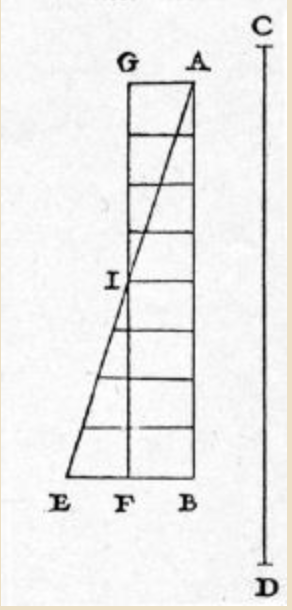
The time in which a certain space is traversed by a moveable in uniformly accelerated movement from rest is equal to the time in which the same space would be traversed by the same moveable carried in uniform motion whose degree of speed is one-half the maximum and final degree of speed of the previous, uniformly accelerated, motion.(23)
Let line \(AB\) represent the time in which the space \(CD\) is traversed by a moveable in uniformly accelerated movement from rest at \(C\). Let \(EB\), drawn in any way upon \(AB\), represent the maximum and final degree of speed increased in the instants of the time \(AB\). All the lines reaching \(AE\) from single points of the line \(AB\) and drawn parallel to \(BE\) will represent the increasing degrees of speed after the instant \(A\). Next, I bisect \(BE\) at F, and I draw \(FG\) and \(AG\) parallel to \(BA\) and \(BF\); the parallelogram \(AGFB\) will [thus] be constructed, equal to the triangle \(AEB\), its side \(GF\) bisecting \(AE\) at \(I\).
Now if the parallels in triangle \(AEB\) are extended as far as \(IG\), we shall have the aggregate of all parallels contained in the quadrilateral equal to the aggregate of those included in triangle \(AEB\), for those in triangle \(IEF\) are matched by those contained in triangle \(GIA\), while those which are in the trapezium \(AIFB\) are common. Since each instant and all instants of time \(AB\) correspond to teach point and all points of line \(AB\), from which points the parallels drawn and included within triangle \(AEB\) represent increasing degrees of the increased speed, while the parallels contained within the parallelogram represent in the same way just as many degrees of speed not increased but equable, it appears that there are just as many momenta of speed consumed in the accelerated motion according to the increasing parallels of triangle \(AEB\), as in the equable motion according to the parallels of the parallelogram \(GB\). For the deficit of momenta in the first half of the accelerated motion (the momenta represented by the parallels in triangle \(AGI\) falling short) is made up by the momenta represented by the parallels of triangle\(IEF\).
It is therefore evident that equal spaces will be run through in the same time by two moveables, of which one is moved with a motion uniformly accelerated from rest, and the other with equable motion having a momentum one-half the momentum of the maximum speed of the accelerated motion; which was [the proposition] intended.
Drake footnote 23: Characteristic of Galileo's concern with actual events (note 8, above) is his utilization of one-half the terminal speed, which could be measured by observing horizontally deflected bodies. Medieval writers assumed an ideal mean-speed to measure every uniformly accelerated motion directly. Galileo's proof matched elements in two infinite aggregates for each instant and all instants, conceiving that in uniform motion there is not one single speed but infinitely many, all equal, and corresponding to the infinitely many speeds, all different, in accelerated motion.